Updated October 2026. If your home sits near the Great South Bay, a canal or a tidal creek, remodeling comes with extra rules and extra opportunities. The same project that is simple a few blocks inland can trigger flood-compliance requirements near the water. Understanding them before you design your project can save you tens of thousands of dollars and months of delay. Here is how it works for homeowners in Islip, Bay Shore, West Islip, East Islip, Babylon and the rest of Long Island’s South Shore.
Why South Shore homes face special rules
The Great South Bay is shallow, and it funnels storm surge from hurricanes and nor’easters toward the communities along its edge. Bay Shore, Islip, Babylon and neighboring areas have a long history of storm flooding, and FEMA flood maps show extensive high-risk zones in the lowest areas nearest the water. Those maps drive three things: what building rules apply to your project, what flood insurance costs, and what lenders require.
Step 1: Find out if you are in a flood zone
Enter your address at the FEMA Map Service Center (msc.fema.gov) to see the flood map panel that applies to your property and its effective date. Maps are updated periodically, so a home that was outside a flood zone years ago may be inside one now. Your building department can also tell you what the Town has on file.
Step 2: Understand the 50% rule
This is the single most important concept for waterfront remodels. FEMA defines a substantial improvement as any reconstruction, rehabilitation, addition or other improvement of a building whose cost equals or exceeds 50% of the market value of the structure before the work begins. If a project crosses that line, the building is treated like new construction for flood purposes. That generally means the whole structure must be brought into compliance with current flood damage prevention rules, which can include elevating it to or above the base flood elevation, using flood-resistant materials and installing flood vents.
What this means in practice:
- A kitchen or bathroom update on its own usually stays well below the threshold.
- A large renovation or a second-story addition on a modest home can approach it.
- The comparison is against the value of the structure, not the land, so a high-priced lot with a modest house can reach the threshold sooner than owners expect.
- How a town tracks improvements, including whether it adds up projects over time, is a local matter. Ask your building department before you plan a phased project.
A good contractor will raise this at the very first meeting, not after you have paid for drawings.
Step 3: Consider an elevation certificate
An elevation certificate is an official FEMA form completed by a licensed land surveyor or engineer. It documents the elevation of your lowest floor relative to the base flood elevation shown on the flood map. It is often required for permitting in flood zones, and it can have a real effect on flood insurance premiums, since National Flood Insurance Program rates depend heavily on how your home sits relative to the base flood elevation. A home that sits well above it may qualify for lower rates.
Remodeling with flood and moisture in mind
Even when your project stays under the 50% line, building smart for water makes your home safer and your repairs cheaper after a storm. Common choices include:
- Water-tolerant flooring such as tile or luxury vinyl plank on lower levels, instead of carpet or solid hardwood
- Moisture-resistant wall materials and closed-cell insulation in basements and lower walls
- Raised electrical outlets, panels and equipment where practical
- Proper drainage and sump systems before any basement is finished, as covered in our basement finishing guide
- Cabinetry and finishes that can be replaced without gutting the whole room
In many flood zones, rules also restrict finished living space below the base flood elevation. If you are thinking about a basement bedroom or in-law suite, ask early what is allowed on your lot.
Waterfront projects we have worked on
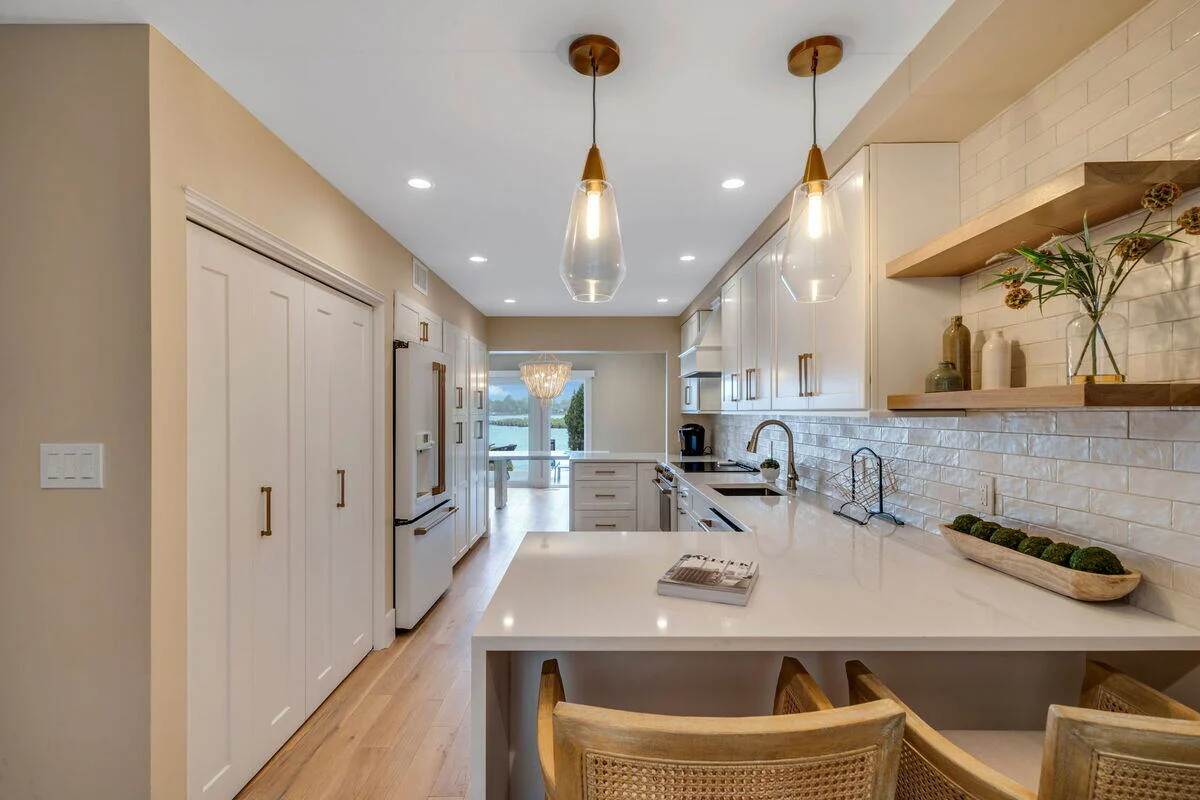
Waterfront and near-water homes are a regular part of our work. In West Islip, we reworked the first floor of an older coastal home with a canal in the backyard for a young family, turning a segmented layout into an open, livable space. See the West Islip kitchen remodel. In Massapequa, a home near the water had been remodeled after Superstorm Sandy by a previous owner, and the new owners needed poorly done work corrected and old asbestos flooring removed, as shown in the Massapequa kitchen and bathroom remodel. Both are reminders that older coastal homes often hide problems that should be priced in from the start.
Checklist before you remodel a waterfront home
- Look up your flood zone at msc.fema.gov.
- Ask your building department how it applies the 50% rule and how it counts previous work.
- Get an elevation certificate if your project is large or if you are changing insurance.
- Have a contractor evaluate moisture and drainage before design.
- Choose flood-tolerant materials for lower levels.
- Confirm permits with your Town: the Town of Islip guide and our comparison of Babylon, Brookhaven and Huntington are good places to start.
Kuhn Construction has been remodeling homes across Suffolk and Nassau County since 1986. Contact us to talk through your waterfront project.
Frequently asked questions
What is the 50% rule for flood zones?
If an improvement costs 50% or more of the market value of the building before the work starts, the building generally must be brought into compliance with current flood requirements, which may include elevating it.
Do I need flood insurance?
If you have a mortgage and your home is in a high-risk flood zone, your lender will usually require it. Even outside those zones, many homeowners choose to carry it.
Can I finish my basement in a flood zone?
Sometimes, but flood zone rules can restrict finished living space below the base flood elevation. Check with your building department before you design.
This article is general information, not engineering, legal or insurance advice. Flood maps and local rules change. Confirm current requirements with FEMA and your local building department.